“Great software isn’t just built with code; it’s built with a disciplined system. Since I respect the confidentiality of my clients and my firm, this page is dedicated to sharing how I work—the methodologies and philosophies I use to ensure every sprint is a step toward excellence.”
1. The Agile Rhythm: Daily Execution & Focus
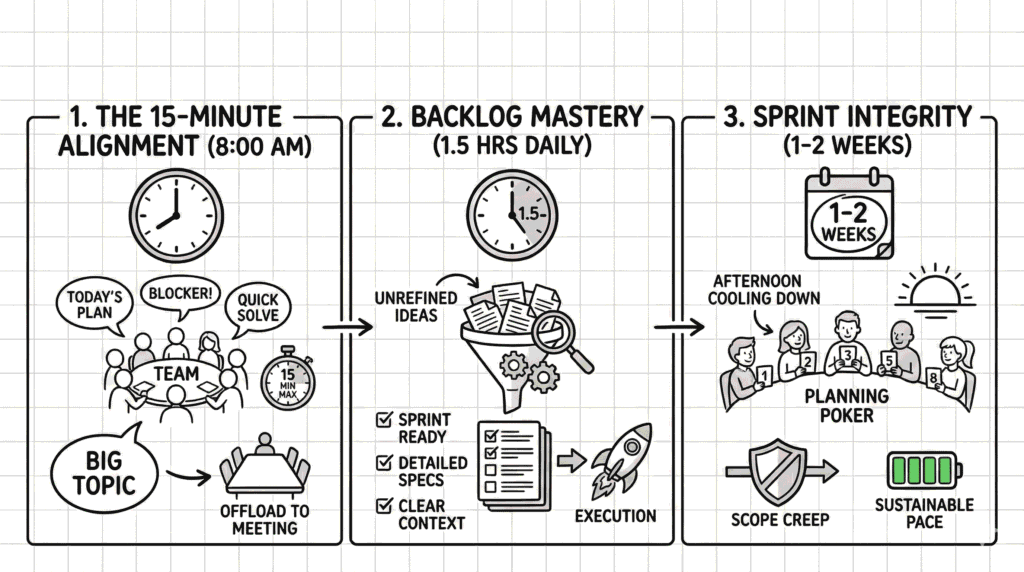
My approach to Agile is not about Following a rigid process, but about adapting it to the team’s DNA.
- The 15-Minute Alignment : My approach to Agile is not about following a rigid process, but about adapting it to the team’s DNA.
- The 8:00 AM Synchronization: I kick off every morning leading the Daily Scrum at 8:00 AM sharp. Each team member outlines their planned tasks for the day, ensuring total transparency and alignment across the board.
- Immediate Problem-Solving: If a team member is stuck or requires a specific solution, we dive deep into the problem and brainstorm collectively on the spot to remove blockers immediately.
- Strategic Offloading: To maintain the core focus on synchronization, I identify complex topics that require larger discussions and offload them to separate meetings. This keeps our morning routine lean, effective, and focused on its primary goal.
- Backlog Mastery (Strategic Grooming & Detailed Execution) : I treat the product backlog like an investment portfolio—constantly grooming and prioritizing it to maintain a healthy project trajectory.
- 1.5 Hours of Daily Focus: I dedicate a specific 1.5-hour window every day solely to backlog grooming. This is a focused session where I refine, prioritize, and prepare the roadmap for upcoming sprints.
- Precision in Documentation: During these sessions, I ensure that every task is described with meticulous detail. My goal is to eliminate ambiguity; by providing clear context and requirements, I empower the team to understand each task fully and execute it correctly the first time.
- Ensuring “Ready” Status: This dedicated time ensures that every ticket meets our “Definition of Ready” before it ever reaches the developers, preventing mid-sprint confusion and maintaining high velocity.
- Sprint Integrity (Realistic Commitments & Sustainable Pace): I protect the team’s focus by rigorously managing scope creep, ensuring we deliver on commitments without burning out.
- Short, Focused Cycles: I operate on tight 1–2 week sprint cycles. This keeps momentum high and enables rapid feedback loops.
- Team-Based Estimation (Planning Poker): Before launching a sprint, the entire team utilizes Scrum Poker to assign story points. This ensures that commitments are based on collective reality, not management assumptions.
- Strategic Scheduling: I intentionally schedule these estimation sessions in the afternoon. It serves as a productive “cooling down” period—shifting gears from high-intensity individual execution to collaborative planning after a hard day’s work.
2. The Translation Layer: Bridging Business & Code
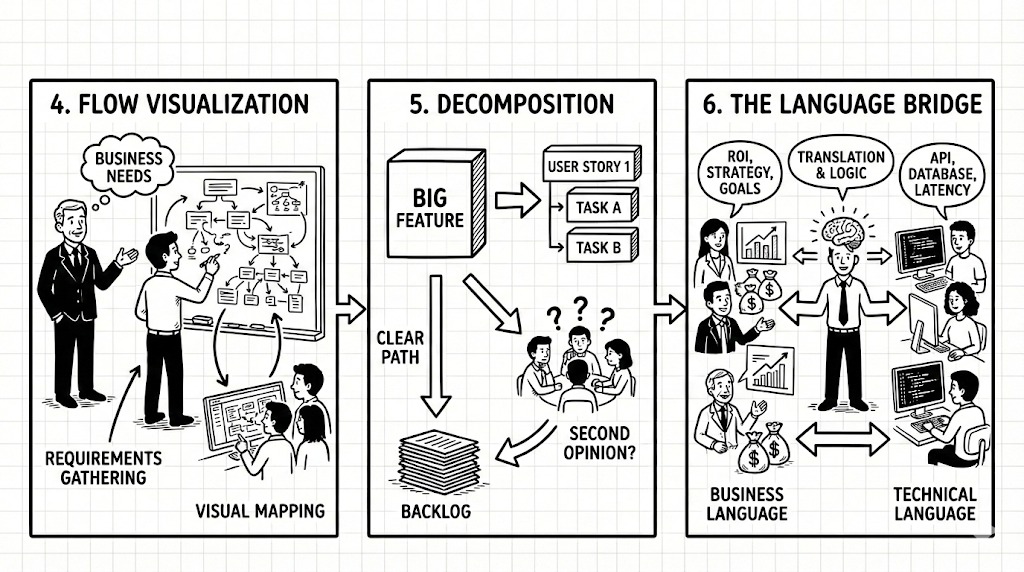
My core strength lies in being the interpreter between two worlds.
- Flow Visualization (Bridging Operational Needs and Technical Execution) : I serve as the primary architect for project requirements, ensuring that high-level business visions are successfully transformed into functional software.
- Multi-Level Requirement Gathering: I engage in direct coordination and intensive meetings with end-users and stakeholders to capture their core needs. This includes high-level strategic discussions with Directors to align the project with overarching operational objectives.
- Operational-to-Technical Translation: Once the requirements are gathered, I translate these abstract operational needs into precise technical specifications. My goal is to create a common language that the development team can understand and execute with high accuracy.
- Actionable Visual Mapping: I utilize visual flows and diagrams to map out complex business logic. This visual roadmap eliminates ambiguity, providing the team with a clear understanding of the “why” and “how” behind every feature they build.
- Decomposition (Precise Breakdown & Collaborative Validation) : I ensure that every massive feature is dismantled into clear, executable steps, leaving no room for guesswork or ambiguity.
- Initial Deconstruction: I begin by personally breaking down large features into smaller, manageable components to grasp the full scope and logic.
- Direct-to-Backlog Pipeline: When the implementation path is clear and straightforward, I immediately translate these components into detailed User Stories and Technical Tasks to keep the development momentum steady.
- Collaborative Second Opinions: For complex or ambiguous features, I actively involve the team to seek a second opinion. This collaborative check ensures we haven’t missed a simpler technical path and often uncovers innovative implementation ideas that are more efficient to build.
- The Language Bridge (Domain Mastery & Logical Deconstruction) : One of my primary core strengths is the ability to navigate seamlessly between the corporate boardroom and the engineering lab.
- Bilingual Proficiency (Business & Tech): I possess an extensive vocabulary in business language, allowing me to communicate ROI, operational impact, and strategic value to stakeholders and directors. Simultaneously, I am deeply fluent in technical language, enabling me to discuss architecture and implementation details with the development team.
- Logical Problem Deconstruction: Beyond just translating words, I apply strong analytical logic to understand complex issues. I excel at taking a vague business problem, deconstructing it logically, and reassembling it into a clear technical roadmap that both sides can agree on.
- Stakeholder-Team Synergy: By speaking the “native tongue” of both management and engineers, I act as a high-fidelity bridge. This ensures that technical limitations are understood by business owners in plain terms, and business goals are crystal clear to the developers in technical terms.
3. The Japanese Influence: Discipline & Kaizen
Working in a Japanese technology firm has instilled in me a deep respect for precision and continuous improvement.
- Hou-Ren-So (Report, Inform, Consult): I ensure communication flows seamlessly, keeping everyone informed and aligned to prevent misunderstandings.
- Nemawashi (Consensus Building): Before major decisions, I lay the groundwork by building consensus with key stakeholders, ensuring smooth execution.
- Continuous Improvement: Every Retrospective is an opportunity to refine our processes, not just to find fault, aiming for a 1% improvement every single day.
4. Risk & Market-Driven Management
My background as a Market Observer directly influences how I manage projects.
- Data-Driven Decisions: I don’t just look at project timelines; I analyze market trends and technological shifts to ensure the product remains relevant and competitive.
- Proactive Risk Allocation: Similar to a DCA investment strategy, I “allocate” buffers for technical risks and uncertainties, ensuring projects stay on track even when challenges arise.